Run five locations and you can manage reputation by hand. Run five hundred and the same job turns into infrastructure. At that size, enterprise reputation management has more in common with a logistics operation than with marketing: a standing process for watching, answering, and learning from whatever customers say about every location you operate.
It covers a lot of ground. Google and Yelp reviews, sure, but also Facebook comments, a TikTok nobody tagged you in, the listing that quietly shows the wrong Sunday hours, the survey a district manager forwards on a Friday afternoon. The reason to pull all of that into one system is consistency. One online reputation. One brand voice people recognize. Held steady across thousands of separate conversations, and somehow without flattening every location into a copy-paste machine.
That tension, consistency against local character, is the part nobody nails on the first attempt. Get it right and reputation management starts paying rent, because the same reviews that defend the brand also tell you which stores to fix. Get it wrong and the bill arrives slowly. One bad Saturday at a single franchise, left to sit, can climb the search results and weld itself to the corporate reputation of all five hundred.
What enterprise reputation management means for multi-location brands
Star ratings are the part everyone stares at. They are also the smallest piece of the work. Enterprise reputation management governs how your brand sounds and what it looks like at every spot a customer checks before spending money, which in 2026 means roughly a dozen platforms, not a single review page.
Three things have to run at once. Listings stay accurate, down to the holiday hours at store 312. Your read on customer sentiment stays current rather than stuck on last quarter’s NPS export. And replies go out fast and in voice, whether the review is five stars or a furious paragraph about a cold order and a rude shift lead. Drop any one and the other two lose their value. A wall of glowing reviews does nothing if the address is wrong and nobody can find the door.
None of it is one and done. The work loops: you watch what lands, respond, hunt for the pattern underneath, then change the actual thing customers keep flagging. The dangerous part is the seepage between locations. A single ugly review almost never stays put. It gets screenshotted, reposted on social media, surfaced by search, and quietly absorbed into how people judge the whole chain. So enterprise reputation management exists to tie each location’s online reputation back to one standard. Let it run loose and the brand stops reading like a brand. It reads like a dozen strangers who happen to share a logo.
Why reputation management gets harder at scale
Complexity outruns headcount. That is the whole problem in one line. Five locations, and a shared inbox plus a spreadsheet hold up fine. Five hundred, and the spreadsheet turns into a liability inside a week.
Look at the surface area first. Each location carries its own profiles on Google, Yelp, TripAdvisor, Facebook, and whatever niche directory rules its category, a Healthgrades for a clinic, an Avvo for a law office. A handful of platforms times a few hundred locations leaves you tracking thousands of review streams in parallel. No team reads that by hand for long without something slipping.
Then comes drift. With no shared playbook, the Phoenix region answers reviews like a friend texting back while the Boston region sounds like outside counsel. Customers feel the seam even when they cannot name it, and the brand identity smears at the edges.
The quietest risk does the most harm: losing the thread entirely. A negative review sits unanswered for three weeks. A listing still shows hours from 2019. On its own, each is a small miss at one store. Stacked across multiple locations, those misses harden into the story search engines tell about you, and past a certain point that story is no longer yours to edit.
The core elements of enterprise reputation management
A program that survives contact with 500 locations tends to have five moving parts, and they only work bolted to each other.
- Review monitoring, which pulls reviews and brand mentions off every platform that counts, for every location, into one feed.
- Listings management, which keeps the name, address, phone, and hours right everywhere a customer or a crawler might look.
- Response management, which gets timely, on-voice replies to the five-star regulars and the one-star blowups alike.
- Escalation, which routes the serious stuff, a food-safety claim, a discrimination accusation, straight to the regional or legal team instead of leaving a store manager to improvise.
- Analytics, which climbs past the average rating to surface themes, sentiment movement, and the specific locations dragging the chain down.
Yank out one part and the rest wobble. Broken listings poison the reviews you worked to earn. Sharp analytics goes to waste if you catch the cleanliness pattern at thirty stores and route it nowhere. The five parts are a reputation management strategy only when they hand off to each other cleanly.
Centralized control and local execution
Corporate control and local voice read like a forced choice. They are not, provided you draw the line deliberately instead of letting it fall where it may. For each slice of the work, settle who at headquarters owns it and what the location runs day to day. Here is where most multi-location brands land.
| Area |
Headquarters owns |
The location runs |
What to measure |
Cost of leaving it alone |
| Brand voice |
Tone rules, response templates, escalation triggers |
Local context, the specifics of the visit, a real greeting |
How closely replies track the style guide |
A brand identity that fractures store by store |
| Review responses |
Policy, approval logic for touchy cases |
The actual reply, written within the guardrails |
Response rate, time to first reply |
Uneven quality, the odd rogue reply that becomes a screenshot |
| Listings |
Master business data, chain-wide attributes |
One-off updates for a closure or a local event |
Listings accuracy across directories |
Lost walk-ins and softer local search rankings |
| Reporting |
The KPI set, dashboards, regional cuts |
Notes from the floor, who the local competitor is |
Whether anyone spots a trend in time |
Systemic issues that nobody catches until they are everywhere |
Every row says the same thing in different words. Headquarters owns the rules and the guardrails. The location owns the human part inside them. That split is what keeps a brand recognizable across all locations without bleaching out the local texture customers actually remember.
How to monitor and respond across every location
The line between enterprise reputation management and frantic firefighting is mostly method. One has a system. The other has a regional VP refreshing Google at 11pm.
Review and social media monitoring across platforms
The conversation does not live in one place. People rate you on Google and Yelp, vent on Facebook and X, and discuss your brand on Reddit and TikTok without ever @-ing the account. That spread is the argument for a centralized monitoring setup. One dashboard lets corporate and regional teams scan the health of every location in a sitting, instead of signing into twenty logins and hoping.
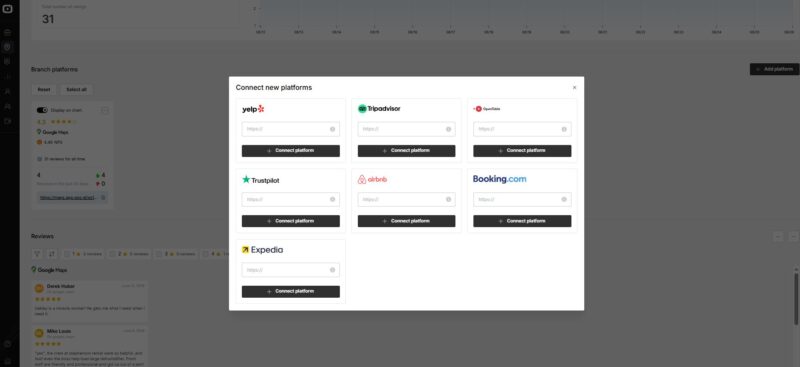
Review monitoring is table stakes. Social media monitoring and social listening are the layer most multi-location brands skip, and it is the layer where trouble shows up first. Monitoring social media catches the complaint that never becomes a formal review, the post about one store that starts to travel, the dip in mood that lands days ahead of any rating change. Media monitoring across news and blogs does the same early-warning job for coverage. Stack review monitoring and social listening together and you are watching the full online reputation, not just the slice that lands on a star-rating site.
Tools range widely. At one end, a plain review aggregator. At the other, a full platform with AI-assisted analytics. When enterprises weigh reputation management software, the short list usually comes down to a few questions: does it pull from every source we care about, does it flag a sentiment swing on its own, and does it slot into the workflow the team already runs. Some products lean on drafting replies, others on spotting patterns across thousands of reviews, plenty add competitor benchmarking. The one worth buying scales across all locations, turns raw reviews into something a manager can act on, and does not bury an already-stretched team in fresh busywork.
Response standards and escalation paths
Replies need a frame, or they wander. The floor is simple: every response reads as a real exchange between people. A calm, fair answer to a harsh but honest review tells the next reader you take complaints seriously, and it ages better than silence ever does.
Some cases need more than a reply. When something false goes up and genuinely dents the business, you want a path to escalate and get it pulled. Run it from gentlest to heaviest:
- Go to the platform first. Use the review site or mapping service’s own reporting and support channels to flag the content.
- Lean on the search engines. If the platform drags its feet, file with Google, which weighs the case and decides whether to strip inaccurate or stale information.
- Bring in legal last. Once the earlier steps stall, a legal route may be the only one left. Hold onto proof the claim is false, the screenshots, the dated records, the paper trail, because the evidence is what carries the day.
How to identify reputation issues early
Catching trouble early comes down to three habits, and none of them are exotic.
Watch constantly. Tracking brand mentions surfaces a sudden spike in chatter, and keeping an eye on social media, images, video, and press flags an emerging issue before it reaches a wider room. The earlier you see it, the cheaper it is to handle.
Read the search box. What people type tells you what they fear: “[brand] reviews,” “[brand] scam or not,” “[brand] lawsuit.” A climb in those queries, or a new sour phrase latching onto your name, is the signal to move. This is the spine of SERM, search engine reputation management, and it shows you what page one of Google says about your brand at this exact moment, which is the version most prospects actually see.
Mine your own customer experience. Pull the questions your sales floor hears on repeat, cross them with what review parsing turns up, then answer them out loud on the channels you control. Publishing those answers ahead of time drains the tension before a customer ever reaches a review box.
How ORM Service helps multi-location brands scale
Reputation work across a few hundred locations outgrows an internal team faster than most leaders plan for. The sheer count of reviews, the demand for consistent responses, the spread across Google, Yelp, Facebook, and a dozen niche sites, it adds up to a real operating load that lands on people who already have day jobs.
That gap is what a professional online reputation management (ORM) service is built to fill. Rather than bolt reputation duty onto a district manager who is already running a P&L, plenty of enterprises hand the daily grind to a team that does only this and has the tooling to do it at scale.
ORM Service runs it as exactly that, a team. You get a dedicated crew of analysts, legal specialists, and a personal manager handling monitoring and response across all locations. The platform puts every review across Google, Yelp, Facebook, and industry sites in one centralized view, pings you when something needs a human, and ships replies that keep your brand voice steady from the first location to the five-hundredth.
Pricing comes in three tiers, all billed per location per month, so the cost tracks how many locations you actually run rather than how loud any given month gets.
| Plan |
Per location / month |
What it adds |
| Starter |
$299 |
Performance dashboard, up to 10 platform integrations, 24/7 monitoring, 100 review requests, 3 removal attempts, a 24 to 48 hour target response |
| Growth |
$399 |
Everything in Starter, plus 250 review requests, campaign analytics, 8 removal attempts, a dedicated removal specialist with priority escalation, and a 4 to 12 hour response |
| Enterprise |
$549 |
Everything in Growth, plus unlimited review request handling, unlimited removal attempts per location, custom-designed QR codes, weekly analytics, and a 2 to 4 hour response |
For a chain running hundreds of locations, the Enterprise plan is the one built for the job. Unlimited removal attempts matter when a fake or defamatory review can land at any store on any day. The 2 to 4 hour target response keeps a local flare-up from climbing into the corporate reputation before anyone notices. And weekly analytics hands regional teams a current read instead of a monthly rear-view mirror. It is the tier that treats reputation management as the operational system a large multi-location brand needs, not a tool you glance at now and then.
Whichever tier fits, the effect is the same. The operational weight lifts off your calendar, the online reputation of every location stays in steady hands, and your own people get back the time for the work only they can do.



