

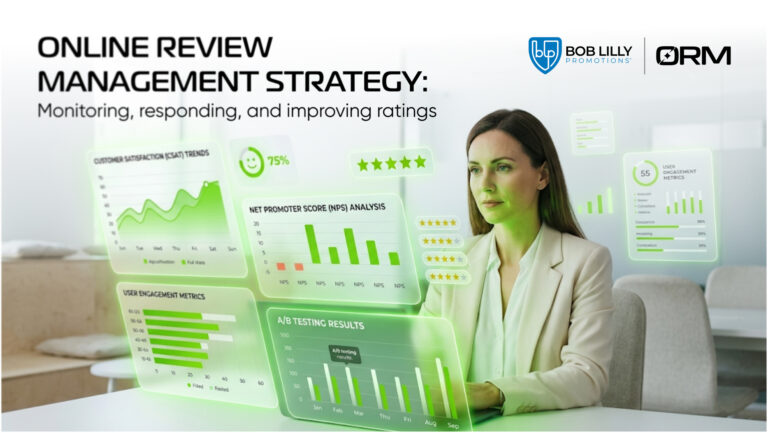
A solid online review management strategy begins with an honest reckoning: nobody dictates what customers write on Google, Yelp, or TripAdvisor. Those opinions land in public view regardless of whether a company is watching. The variable that separates thriving brands from vulnerable ones is operational—how quickly customer feedback gets spotted, how deliberately the team replies, and how rigorously leadership mines recurring themes for improvement.
Below is a stage-by-stage breakdown of a functional review management strategy—covering review monitoring, triage logic, response technique, data-driven improvement, and ethical review generation. Built for marketing teams, franchise operators, and local businesses that need results this quarter.
What online review management really means
Online review management covers far more territory than answering stars-and-text posts. It is the discipline of capturing, categorizing, replying to, and extracting intelligence from every piece of public customer feedback. Most organizations fixate on the reply itself and overlook systematic review monitoring, priority routing, sentiment analysis, and post-response operational adjustments.
People often conflate watching reviews with governing online reputation. Those are distinct activities. Watching reveals what buyers wrote. Governing means routing that intel to the correct department, resolving friction, and proving through subsequent reviews that things changed. One produces awareness; the other produces movement.
Scattered replies never compound into a strategy. When one branch tackles Google while a colleague ignores Facebook, and nobody compares cross-location patterns, the organization is merely reacting. A genuine online review management strategy welds isolated actions into a unified, repeatable process with named owners and trackable targets.
Why review management matters now
Online reviews have replaced word-of-mouth as the dominant form of social proof. Prospective buyers almost always scan public feedback before they dial or click “Add to cart.” BrightLocal’s 2024 survey confirmed that 87 % of people consult online reviews when evaluating local businesses. This is no longer supplementary—it is the opening impression.
Revenue correlates tightly with ratings. A Google listing above 4.0 attracts measurably more taps and phone calls. Shifting an average upward by even a tenth of a point changes how prospects rank a company against nearby rivals on the same search page.
Important! Public perception pivots on review activity faster than on almost any advertising format. One unanswered low-star post can neutralize weeks of paid promotion, whereas a cluster of fresh five-star entries can elevate credibility in a single weekend.
Local search ranking draws partly on review signals: volume, freshness, ratings, and topical relevance. Google’s help pages acknowledge that reviews influence local placement. Sidelining review management surrenders local discoverability to competitors who pay attention.
The review management flywheel
Picture review management as a flywheel rather than a task list. Every rotation follows the same arc: Monitor → Prioritize → Respond → Learn → Improve → Spark better experiences. Kept in motion, that cycle pushes ratings upward—not through solicitation tricks, but because the underlying customer experience genuinely gets better with each pass.
Too many organizations treat review work as disconnected chores. A working strategy turns each reply into a learning event, each insight into a process correction, and each correction into a stronger outcome. Energy compounds. That compounding effect is the flywheel.
Stage 1: monitor reviews across every channel
A review that nobody reads might as well not exist. The entire strategy rests on wall-to-wall platform coverage. Relying exclusively on a single source—typically Google—guarantees blind spots where dissatisfied buyers voice complaints unseen.
Google Business Profile and major review site
Google Business Profile dominates visibility for neighborhood businesses, yet Yelp, Facebook, TripAdvisor, and the BBB each command their own loyal audience. A centralized dashboard that pulls listings from every major review site into a single view eliminates coverage holes and slashes the odds of overlooked feedback.
Social media and local platforms
Social media commentary—Facebook recommendations, Instagram threads, Nextdoor neighborhood posts—rarely looks like a traditional review. A disappointed customer might vent inside a comment rather than filling out a star-rating form. Real-time alerts tied to brand-name mentions across social channels seal that gap.
Industry-specific review sources
Medical practices should watch Healthgrades and Zocdoc. Law firms need eyes on Avvo. Contractors depend on Angi and HomeAdvisor. Overlooking vertical portals means losing touch with the precise audience segment that drives the most qualified leads.
Stage 2: prioritize what needs a response first
Not every post warrants the same tempo or depth, yet each one deserves a defined response workflow. The trap most organizations fall into is blanket treatment—answering everything identically or cherry-picking only alarming entries. A triage protocol brings order to the queue.
A workable triage matrix sorts incoming entries by severity and character:
- one- or two-star posts citing a concrete incident;
- public accusations containing factual errors requiring correction;
- mid-range feedback with operationally useful detail;
- glowing endorsements from repeat or high-spend clients;
- brief five-star entries with minimal commentary.
Low-star entries always jump the line. A negative review sitting without a reply for two full days broadcasts indifference to every prospect scrolling the thread. Posts referencing safety hazards, legal allegations, or staff misconduct require escalation paths directed at senior leadership.
Stage 3: respond in a way that protects trust
Responding to reviews is the outward-facing layer of the strategy, which is why polish outweighs haste. A rapid but hollow answer can inflict more reputational wear than a slightly delayed, carefully worded one.
How to respond to positive reviews
Positive reviews call for more than a stock “Thanks for the kind words!” Pick out a concrete detail, name the team member or branch if relevant, and cap the reply at two or three lines. Templated gratitude tells readers nobody absorbed what was written.
How to respond to neutral reviews
Three-star entries that blend compliments with complaints rank among the most instructive. Express appreciation, name the shortcoming, and propose a follow-up. These posts spotlight where the experience nearly succeeded yet fell short.
How to respond to negative reviews
Negative reviews demand empathy, economy of words, and a visible next action. Apologize for the situation—not for how the person feels. Outline the corrective step. Invite continuation via private channels. Never debate. Each review response addresses the hundred silent readers who will judge the brand long after the complainant moves on.
Three guiding principles that hold steady regardless of star count:
- Lead with recognition: Open by validating the reviewer’s experience. People need proof they were heard before they will listen.
- Anchor in specifics: Vague lines like “We value your input!” register as robotic. Mirror the scenario the reviewer described.
- End with direction: Spell out the next action—a phone call, a correction, or a personal invitation to revisit.
Response consistency across branches draws the line between strategy and improvisation. Human-written responses aligned to brand voice guard against the jarring mismatch customers detect when one branch sounds hospitable and another sounds like a chatbot.
Stage 4: use review insights to improve ratings
Ratings do not climb because a company floods inboxes with review requests. They climb because the friction points behind poor scores get eliminated. Review analytics paired with sentiment analysis convert scattered opinions into a ranked queue of operational weak spots.
An insight-extraction workflow should cycle through these steps on a recurring basis:
- Surface repeated grievances – When three buyers in 30 days flag slow reception, that pattern points to a systemic bottleneck.
- Pinpoint service weak links – Mine three-star entries for the “good but could be better” refrain. It nearly always highlights one underperforming touchpoint.
- Push fixes to process owners – Findings belong with the accountable team, not in a marketing slide deck.
- Bring reviewer language into huddles – Verbatim customer quotes land harder in staff meetings than managerial summaries.
- Elevate the source experience – Superior delivery is the strongest review strategy. Every other tactic is secondary.
Location-level reporting scales this discipline across franchises and multi-location networks. Stacking sentiment analysis data location by location exposes underperformers and top-tier sites whose playbooks deserve replication.
Stage 5: build a review generation system without breaking trust
Growing review volume legitimately belongs inside the strategy—provided ethics stay non-negotiable. The objective is to lower barriers for pleased buyers, not to pad stats. All mainstream review sites ban incentivized or gated submissions, so the mechanism must be clean from day one.
Important! Offering discounts, freebies, or loyalty points in exchange for a review violates the published guidelines of Google, Yelp, and virtually every other platform. Penalties range from mass review deletion to account suspension—fallout that dwarfs any temporary rating bump.
A clean generation framework rests on a handful of firm boundaries:
- Trigger the request immediately after a high-satisfaction interaction, while the memory is vivid.
- Minimize steps by embedding a one-tap link to the target platform inside an SMS or email.
- Cap request frequency per customer so follow-ups never cross into nuisance territory.
- Tie every outreach to a confirmed positive encounter rather than a blanket CRM automation.
- Maintain full transparency—recipients should recognize the ask for what it is, with no deceptive framing.
When solicitation consistently yields tepid three-star posts, the bottleneck is not delivery timing—it is the experience behind the curtain.
What KPIs actually matter in review management
Sound metrics anchor a review management strategy in observable reality rather than instinct. Far too many departments glance at the composite star average and move on. Reputation analytics should illuminate momentum, reply discipline, and qualitative direction—not a lone digit.
The quantitative metrics that deserve a permanent slot on the dashboard:
- average star trajectory measured across 30-, 60-, and 90-day windows;
- monthly review count segmented by location;
- freshness ratio (share of entries posted within the prior 90 days);
- reply coverage percentage and median reply latency.
On the qualitative side, track sentiment direction, recurrent complaint categories, and per-location anomalies. Together, these data points reveal whether trajectory is positive or declining and where investigation should start.
Below is a reference grid linking each KPI to its diagnostic value and recommended next action:
| KPI | What it tells you | Why it matters | What to do next |
| Average rating trend | Directional shift in buyer sentiment | Confirms or disproves that fixes are taking hold | Investigate lagging branches; export winning tactics from top scorers |
| Review volume | Breadth of public feedback | Thin volume masks issues and weakens credibility | Expand generation touchpoints at high-traffic moments |
| Response rate | Share of posts that received a reply | Unaddressed entries erode public trust | Target 95 %+; assign a named owner per branch |
| Response speed | Elapsed hours from posting to reply | Prompt answers signal organizational attentiveness | Benchmark under 24 hours for sub-three-star posts |
| Sentiment trend | Emotional arc of aggregate feedback | Detects mood swings before star averages budge | Escalate downward dips to operations for root-cause review |
| Recurring themes | Topics surfacing across multiple posts | Pinpoints systemic drivers behind depressed scores | Assign each theme to a specific process owner |
Common mistakes that break a review strategy
Even teams with the best intentions stumble into habits that quietly corrode review management effectiveness. Certain pitfalls are glaring; others creep in slowly and surface only when ratings begin a steady slide.
The most destructive patterns recur with remarkable consistency across industries:
- Engaging only with criticism. Overlooking positive reviews tells enthusiastic customers their praise carries no weight.
- Absent reply guidelines. When ten branches craft answers in ten incompatible tones, the brand identity fractures.
- Sluggish or irregular responses. A reply that arrives fourteen days late conveys apathy as loudly as total silence.
- Undefined accountability. Unless somebody’s role description explicitly covers review responses, execution will be sporadic at best.
- Recycled boilerplate replies. Identical wording spread across dozens of posts reads as automated and dismissive.
- Obsessing over the number alone. A 4.6 star average rings hollow if the same operational complaint keeps appearing.
- Operating without data. Minus review analytics, teams resort to guesswork about what customers actually think.
A shared thread runs through most of these errors: the organization classifies review management as peripheral busywork rather than a core operational function deserving dedicated headcount and explicit KPIs.
How ORM Service helps teams run review management at scale
When review responses span half a dozen platforms and dozens of branches, manual coordination hits a hard limit. ORM Service dissolves that bottleneck with a centralized dashboard that consolidates every listing—Google, Yelp, Facebook, vertical directories—into one operational view.
Review monitoring operates around the clock, and real-time alerts ping the assigned team member the instant a new entry posts. Reputation analytics combined with location-level reporting expose rating trajectories and struggling branches—no spreadsheet assembly required.
The platform delivers human-written responses composed in each brand’s authentic voice. Adjustable response workflows enable custom triage rules, ownership assignments, and reliable response consistency across every branch—translating into less manual labor and stronger multi-location visibility. See how it works at ormservice.com.
Conclusion
Managing reviews is an operational commitment, not a marketing accessory. Organizations that institutionalize the process—with defined stages, named owners, and enforceable standards—reliably outpace those that improvise. Star averages mirror lived experience; elevate the experience and the numbers trail upward.
Launching from zero? Three opening moves build traction. Audit every platform where buyers can post and patch monitoring gaps. Draft a triage-and-reply protocol so each team member knows the drill when a new post appears. Select one KPI—response rate works best at the outset—and measure it weekly. The strategy itself is straightforward; the advantage lies in relentless consistency.



 Boost Your Reputation Now!