Barbra Streisand’s lawyers wanted one photograph gone. The $50 million suit they filed in 2003 over an aerial shot of her Malibu estate achieved the opposite of erasure: an image six people had bothered to download (two of them her own attorneys) pulled in more than 420,000 visitors within a month of the headlines.
Anyone tempted to scrub a one-star review should sit with that math for a moment. Wanting bad press to vanish is human. The vanishing act itself is what tends to go wrong.
What Is the Streisand Effect? Meaning and Definition
Strip the streisand effect meaning down to a single sentence and you get a paradox: the harder a person or organization fights to bury a piece of information, the brighter the spotlight on it burns. Each attempt to hide, censor, or remove the offending material doubles as free advertising for it. Suppression turns into a headline of its own, content a dozen people had seen becomes visible to millions, and the very effort to prevent access earns the material greater attention than silence ever would.
Nothing about this is planned. The phenomenon is an unintended consequence, and it happens for two stubborn reasons. Audiences read takedown attempts as a confession that something juicy is being hidden, which makes them dig. And online, copying outruns deleting: copies multiply faster than they can be wiped, so when someone tries to delete a post, the move actually advertises it.
Origins of the Streisand Effect
Censored books were selling out centuries before anyone owned a modem. The label itself, though, was born out of one stubborn dispute over the California shoreline.
How a Private-Property Dispute Birthed the Phenomenon
Kenneth Adelman had spent years photographing the California coast from a helicopter, roughly 12,000 frames in all, for the Coastal Records Project, an open archive built to track shoreline erosion. Frame 3850 caught Streisand’s clifftop compound by accident. Her 2003 privacy suit demanded the picture’s removal, plus damages.

She lost. The court tossed the case and billed her for Adelman’s legal costs. The lasting price, though, was paid in attention: reporters covered the suit, and hundreds of thousands of people came looking for one frame in a niche environmental archive. A photo that had interested almost nobody became the most widely seen image of the estate.
Why the Name “Streisand” Stuck
Credit for the coinage goes to Mike Masnick of Techdirt. In 2005 he was covering a beach resort that had fired off legal threats at a hobby website for posting pictures of its restrooms, of all things. How long, Masnick wondered, before lawyers figure out that trying to suppress something online only multiplies it? He proposed naming the pattern after the singer, and the internet agreed.
The shorthand survived because the source case was almost laboratory-clean: famous plaintiff, harmless photo, outcome inverted. Within a few years the term had spread from tech blogs to newspapers and legal commentary.
Real-World Examples of the Streisand Effect
More than two decades on, the case file keeps growing, and the plot rarely varies. Whatever the industry, the cover-up upstages the original sin.
Corporate Attempts to Suppress Negative Reviews
KlearGear, an online gadget retailer, billed a Utah couple $3,500 in 2012 over a sour review, citing a non-disparagement clause buried deep in its fine print. National outlets pounced a year later, the couple sued and won in 2014, and the brand became a consumer-rights cautionary tale. Congress later closed the loophole for good: the Consumer Review Fairness Act of 2016 outlawed gag clauses in form contracts.
The Union Street Guest House in upstate New York tried its own version, threatening wedding parties with a $500 deduction for every negative review a guest posted. The press found the policy in 2014. Within days the hotel’s Yelp profile drowned in one-star ratings from strangers, and management quietly deleted the rule. The reputation never quite recovered.
Public Figures and Censorship Backlash
Beyoncé’s team learned the lesson in 2013, when her publicist emailed BuzzFeed asking the site to pull a handful of unflattering Super Bowl performance shots. BuzzFeed ran a post about the email instead. The photos, which most readers had scrolled past, spent the rest of the year as meme material.
Ryan Giggs went further and used the courts. The footballer’s 2011 superinjunction forbade UK media from linking his name to a tabloid story; Twitter users typed it tens of thousands of times within days, and an MP finally said it aloud in the House of Commons under parliamentary privilege. The gag order shielded nothing and signposted everything.
Lawsuits That Amplified the Original Story
Courtrooms feed the effect especially well. Filings sit in public dockets, meaning a legal threat manufactures its own searchable paper trail. When the Church of Scientology pressured platforms in 2008 to delete a leaked Tom Cruise recruitment video, the purge birthed Project Chanology, a global protest wave, and handed the clip a far wider audience.
Even a landmark of European privacy law carries the fingerprint. The 2014 right-to-be-forgotten ruling began with a Spaniard asking Google to delist a 1998 newspaper item about an auction tied to his old social-security debts. He prevailed at the EU’s top court, and his once-microscopic debt notice was promptly retold by news desks worldwide.
Why Hiding Negative Reviews Always Backfires
None of this is coincidence. A handful of mechanisms stack on one another, and platform design amplifies each.
Psychology supplies the engine. Reactance, the reflex to push back against restriction, makes a forbidden post irresistible: tell readers they cannot see something, and seeing it becomes the whole point. Add scarcity. The instant a review vanishes, screenshots of it gain trophy value.
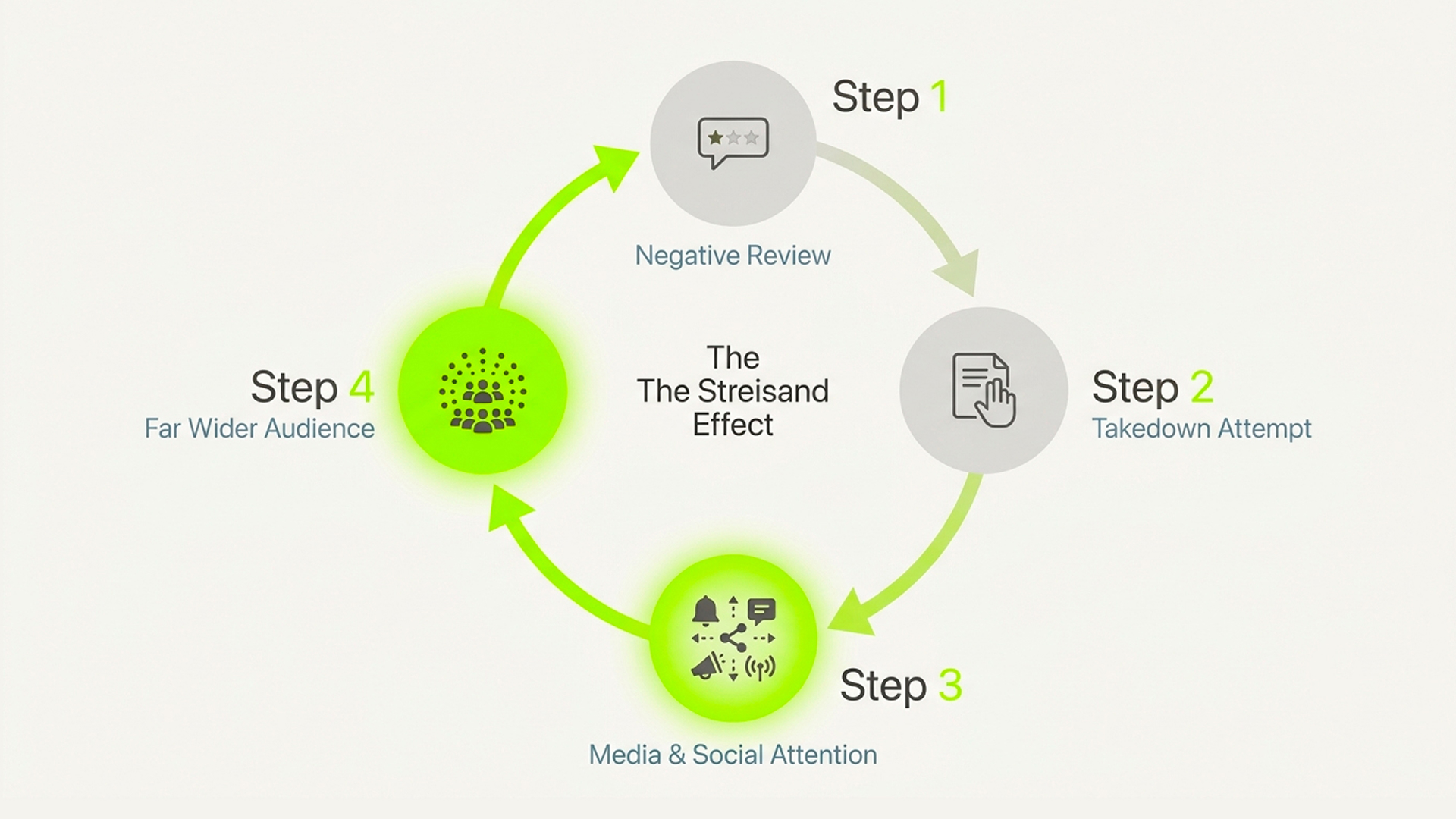
Then the practical machinery kicks in:
- Nothing truly deletes. Web archives and cached copies outlive originals, and a screenshot crosses the internet faster than a takedown notice does.
- A removal demand is a fresh headline. Replying to criticism bores editors; threatening a reviewer with court papers does not.
- Platforms watch for manipulation, flagging businesses that mass-report critics, while an overnight ratings jump reads as fraud rather than improvement.
- And readers draw their own conclusion: whatever someone fought hard to bury was probably true.
Still, not every removal request detonates. Quietly flagging a review that violates platform rules, or one stuffed with fabricated claims, gets handled without drama every day. What leads to the blowback is heavy-handed, public pressure on honest opinion: the act itself reads as an admission, inadvertently handing the critic a megaphone.
Suppression has a working substitute, and it costs less: answering. A business under fire reliably controls exactly one variable: its next move.
Where reviews are concerned, four habits shrink the situation instead of feeding it:
- Answer fast, in public, in a level tone. Readers weigh the reply at least as heavily as the complaint above it.
- Repair whatever broke, then say so. A follow-up note (“the kitchen has had a new manager since March”) keeps persuading long after the dispute cools.
- Reserve flagging for genuine rule-breakers: fabricated reviews, threats, sabotage by competitors. Honest anger does not qualify.
- Outgrow a bad review rather than erasing it. Two dozen fresh, real testimonials bury one rant deeper than any takedown could.
This is the line our dispute work sits on. We file only against reviews that break a platform’s own rules, with the documentation the platform asks for, and we leave honest criticism alone, because trying to force down a real opinion is exactly what turns one review into ten. When a review genuinely violates policy, a managed dispute process is the quiet version that does not backfire.
Court remains the option of last resort, fit for provable defamation with measurable damages, and even a winning case deserves skeptical arithmetic first. A verdict may go your way while search results never do.
The principle stretches past review pages. Editors and regulators tend to soften toward those who engage and harden against those who apply pressure; a polite correction request lands nothing like a cease-and-desist.
Cultural Impact and Modern Usage of the Term
The expression long ago outgrew the blog where it appeared. Judges cite it in opinions, PR curricula teach it, reference publishers keep entries on it. Among communications professionals the phrase serves one job: a warning label on any plan that opens with “make it disappear.”
Its meaning keeps stretching, too. Today the term attaches to any backfiring bid at suppression, whether the target happens to be a meme, a leaked memo, a study, or a state document. The core lesson has not moved an inch since 2003. Online, resistance is a magnet for attention, and the surest way to keep a piece of information obscure is, oddly enough, to ignore it.



