

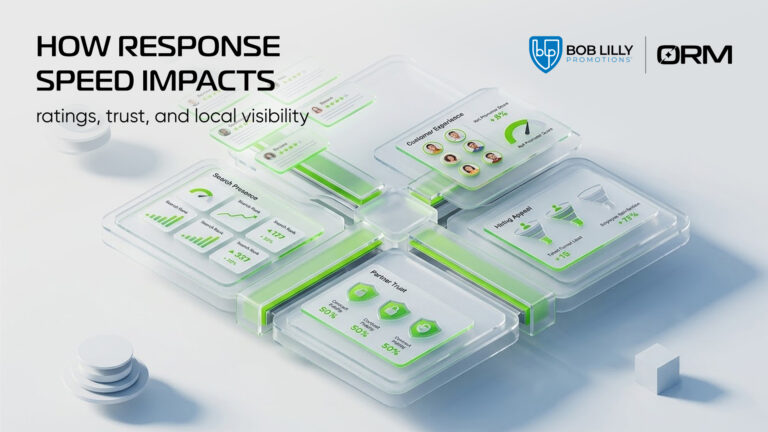
Most business owners view review replies as customer service. That is a mistake. Responding to feedback directly affects local SEO, reputation, and revenue. This article explains how response speed impacts ratings, trust, and local visibility. You will get data, psychology, and actionable steps. No fluff.
Why Response Speed Matters More Than You Think
Google evaluates how businesses interact with customer feedback, and response speed plays an important role. Fast replies show that a business is active and attentive to its customers, while slow responses can signal neglect. In local search, even small engagement signals can influence visibility.
User perception also changes depending on how quickly a company reacts. If a potential customer sees a complaint that has remained unanswered for weeks, trust drops immediately. But when the business responds quickly with an apology and a solution, it creates the impression of responsibility and care. That perception often determines which company a customer chooses.
The Connection Between Response Speed and Local Rankings
Google favors profiles that show regular activity. Businesses that receive new reviews and respond quickly appear more active than those that ignore feedback.
Each response adds fresh user-generated content to a Google Business Profile and signals engagement with customers. Active profiles tend to perform better in local search, while slow or inconsistent responses can weaken visibility in the local pack results.
How Response Speed Builds Customer Trust
Customer trust forms in small moments. A customer leaves a review. You reply within an hour. They feel valued. That feeling spreads—they tell friends, return, become loyal.
Now flip it. A customer leaves a review. Days pass. Nothing. They assume you do not care. They post again, angrier. Or they just never come back. Everyone reading that review sees your silence.
Customer trust is fragile. A fast response says “we are here.” A slow response says “we are absent.”
Response Speed as a Local Visibility Signal
Local visibility follows a simple formula: proximity plus relevance plus prominence equals ranking. Speed feeds prominence. Google calculates prominence partly through engagement. Fast replies equal higher prominence. This directly impacts search visibility.
In competitive markets, proximity and relevance often match. Two dentists on the same street. Same services. Similar websites. Who wins? The one with better engagement—higher response rate, faster response time. Speed becomes the tie-breaker for local rankings.
This applies everywhere: Google Maps, organic local search, Facebook, Yelp. Visibility follows activity. Activity requires speed.
The Metrics That Matter: Response Time, Rate, and Recency
You cannot improve what you do not measure. Three metrics define review management:
- Response Time. The average time between a review posting and your reply. Measure weekly. Track by platform.
- Response Rate. The percentage of reviews receiving replies. Below 100% signals a problem. Every review deserves acknowledgement.
- Review Recency. How often new reviews appear and how quickly you engage. Review velocity matters. Fresh feedback with fast replies creates activity spikes. Google favors spikes.
- Track these three. They reveal more about local search health than any other data.
What Happens When You Respond Slowly
Silence costs money:
Trust Erosion. Customers interpret no response as no care. They choose competitors.
Ranking Decline. Google detects inactivity and lowers your priority. You drop from the local pack.
Negativity Dominance. Unanswered negative reviews sit at the top. They look permanent. No counter-response means complaints stand unchallenged.
CTR Drop. Users see abandoned profiles and click on competitors with recent engagement.
Ideal Response Times: What Does “Fast” Really Mean?
Under 1 Hour. Elite level. Requires dedicated staff and alerts. Customers notice. Google notices.
- 1 to 4 Hours. Still excellent. Most customers are impressed. You beat 90% of businesses.
- Within 24 Hours. Minimum standard. Meets expectations but gains no edge.
- 24 to 48 Hours. Warning zone. Customers start wondering. The algorithm downgrades you.
- Over 48 Hours. Failure. You actively harm your reputation.
Google reviews need the fastest response. Facebook can be slower. Yelp users expect less urgency. But aim for under 24 hours everywhere, with under 4 hours on Google.
Table: Impact of Response Speed on Key Metrics
| Speed Tier | Rankings | Trust | Conversion |
| Under 1 Hour | High | High | High |
| 1 to 4 Hours | High | High | High |
| Within 24 Hours | Medium | Medium | Medium |
| 24 to 48 Hours | Low | Low | Low |
| Over 48 Hours | Negative | Negative | Negative |
How to Improve Response Speed Without Sacrificing Quality
Fast replies without empathy fail. Here is how to balance both:
- Assign Clear Ownership. One person owns replies. Not “the team.” One human with a backup.
- Use Templates—But Customize Every Time. Templates save time. But edit each before posting. Add names. Reference specifics. This is core to strong response management.
- Set Up Real-Time Alerts. Email, SMS, Slack. The first hour after a review is golden. Do not waste it.
- Prioritize Human-Written Touch. Customers detect automated responses. Fast, human replies build trust. Fast, generic replies destroy it.
Important! “Fast but generic” damages reputation as much as slow replies. Google warns against spammy responses. Fast plus thoughtful wins. Fast plus robotic loses.
Short Reply Templates
| Review Type | Template | Customization Tip |
| Positive | “Hi [Name], thank you! We are happy you enjoyed [specific detail]. Hope to see you again.” | Replace [specific detail] with what they praised. |
| Mixed | “Hi [Name], thanks for your feedback on [specific detail]. We will use it to improve.” | Acknowledge their specific point. |
| Negative | “Hi [Name], we are sorry. Please contact [name] at [email] so we can make this right.” | Move offline. Provide a real contact. |
| Question | “Hi [Name], great question! [Answer]. Call us at [number] if you need more.” | Answer concisely. Invite further conversation. |
| Neutral | “Hi [Name], thank you for stopping by! We appreciate your feedback.” | Short and sweet. Acknowledges their existence. |
How ORM Service Helps You Master Response Speed
Scaling speed is hard. ORM Service makes it manageable:
- Centralized Dashboard. All platforms in one view. No switching tabs. No missed reviews.
- Real-Time Alerts. Instant notification when reviews drop. Zero delay.
- Response Workflows. Assign reviews to the right people. Nothing falls through cracks.
- Multi-Location Consistency. Maintain consistent tone and speed across all branches.
- Human-Written Responses. No auto-reply bots. Every response is human-written and customized.
- Reputation Analytics. View response rates and times by platform, location, and team member.
Want to see how fast your team can respond? Request a demo.
Common Mistakes That Slow Down Your Response Time
No Clear Owner. “If everyone is responsible, no one is responsible.” Assign one person.
Fear of Saying the Wrong Thing. Some freeze, wanting perfection. They write nothing. Perfect is the enemy of done. Reply within hours. Refine later.
Weekend Blindness. Reviews continue on weekends. Have coverage. A negative review sitting all weekend hurts.
Only Answering Negative Reviews. Positive reviews need love too. Answer everything.
Copy-Paste Without Editing. Templates are tools, not crutches. Edit every time. Make it personal.
Conclusion
Speed is not optional. Response speed impacts ratings, trust, and local visibility across every business dimension. Fast replies build customer trust, signal engagement signals to Google, lift local pack profiles, and drive conversions. Slow replies erode trust, lower local rankings, and hand customers to competitors.
Review your process today. Measure actual response time. Build a system that makes fast, human replies the norm. Your star ratings will improve. Your search visibility will grow. Your customers will notice. Your business will thrive.

 Boost Your Reputation Now!