A customer drops a one-star review on your Facebook page at 9 p.m. By morning four other people have read it, one has piled on in the comments, and a fifth has quietly crossed you off the list. None of that ran through your marketing team. That is the part of your brand you don’t get to script, and it happens to be the part buyers trust most.
Social media reputation management is how you stay on top of it: catching what people post, working out what they actually mean, and answering so the brand sounds like one company every time. This guide walks through what it covers, why it tips brand trust one way or the other, where it plays out, and how to run it without living in a dozen browser tabs.
Strip the jargon and it’s three jobs done on repeat. Watch for new reviews and mentions. Work out whether the mood is warming or souring, and why. Reply in a way that fits the brand and settles the matter. Do those across the places customers actually post, and you’re managing your social reputation.
The work runs opposite to marketing, even though the two share a calendar. Marketing decides what the brand says. Reputation management deals with what everyone says back, which is messier and almost never on schedule. A glossy launch post and the furious comment underneath it call for two different skills, and only one of them can wait until Monday.
It also refuses to sit in one place. A Facebook review, a Reddit thread, a Nextdoor recommendation, a one-star rating buried on a booking site: each one nudges the same gut feeling a stranger forms about you. Treat them as a single feed, not six inboxes nobody fully owns.
Buyers vet you before they pay, and they do it by reading what other people wrote. A rating, a recent comment, the reply you left under a complaint: those now land somewhere close to a friend’s tip. BrightLocal’s 2026 Local Consumer Review Survey puts it at 97% of consumers reading reviews before they pick a local business, with 41% saying they never skip them. Your profiles are selling for you or scaring people off around the clock, whether or not you’re watching.
Freshness and answers count for as much as the star average. A page with comments from this week and visible replies says someone’s home. A page gone quiet says the opposite, and an unanswered complaint hands the next reader a preview of how you’ll treat them.
Bad news also outruns good. One clip or screenshot can wipe out months of quiet, competent work in an afternoon. That lopsidedness is the whole argument for early over thorough: spot the spark, not the fire.
Your reputation doesn’t live on one network. It collects wherever your customers happen to talk, and which network matters most swings hard by industry. A handful carry outsized weight for nearly everyone, and each rewards something different.
Facebook and Nextdoor
Facebook is where plenty of customers still drop a recommendation, fire off a Messenger question, or vent about a visit. Its recommendations surface in search and tip nearby buyers one way or another. Nextdoor runs even more local: a single “anyone know a good plumber?” thread can hand a competitor the job before you’ve finished your coffee. Answer fast and by name on both, or let the silence speak for you.
Instagram, TikTok, and YouTube
Visual, fast, and mostly out of your hands. The comments under your posts, the accounts that tag you, the unboxing and review videos: those move opinion more than anything you publish yourself. One creator’s throwaway line can outreach a paid campaign, and one stiff, defensive comment-reply can do the reverse just as fast.
LinkedIn, X, and Reddit
LinkedIn is where professional and B2B trust lives or dies, as employees and clients either speak up for you or stay quiet. X rewards speed, which suits live support and announcements. Reddit runs on long, unsparing threads that age well in search, so honest answers help you and a sales pitch gets shredded.
None of this is a one-time scrub. It’s a loop, and the reason to write it down is that a small team can actually keep the loop turning. Here’s the version that holds up.
- Catch mentions as they land. Set up tracking for your name, your products, the misspellings people actually type, and anyone who fronts the brand in public, across the networks and review sites where your buyers spend time. Real-time alerts are what stop a small fire from spreading overnight.
- Read the mood, not the count. Split what comes in into positive and negative, then dig for the reason underneath: the product, the price, the wait, the person at the counter. A run of similar complaints tells you where to fix something. A single one usually doesn’t.
- Answer quickly, and sound like yourself. Warm for the praise, level-headed for the criticism, owning the problem, and moving the heated ones to DMs. How fast you reply gets read by everyone who scrolls past afterward, not only the person who complained.
- Write the crisis plan before you need it. Settle up front on what counts as a real emergency, who gets to speak, and how you pull the scheduled posts. Handled calmly and in the open, a bad day can end up proving you’re dependable.
- Feed the good stuff. Ask for a review when the customer is happiest, not a week later, and pass along the honest content people make about you. A real customer’s post beats anything you’d say about yourself.
The glue is consistency. The moment more than one person, or more than one location, starts replying, you need shared guidance on tone and timing, or the brand starts sounding like a roomful of strangers who’ve never met.
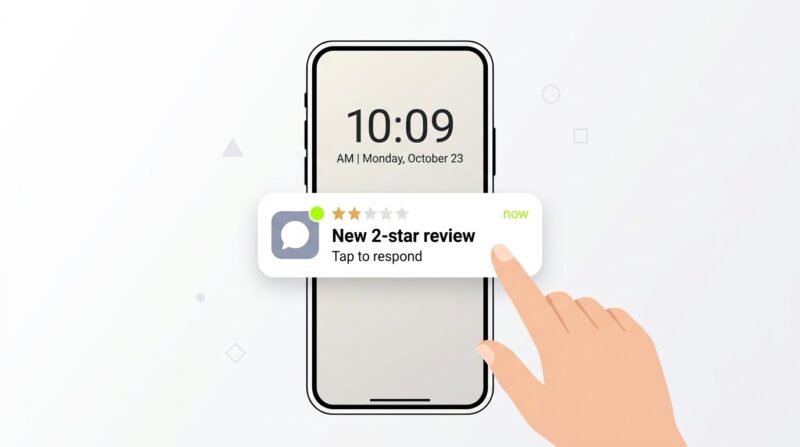
Doing this by hand works right up until it doesn’t, usually the week a second location or a fifth review site joins the picture. A platform earns its keep by watching and sorting what no person can track across that many sources at once. When you compare options, these are the capabilities that separate a tool that helps from one that just adds another login.
| Capability |
Why it matters |
| Monitoring across many sources |
Social and review-site feedback lands on one screen, not behind a dozen passwords |
| Real-time alerts |
A cluster of angry reviews reaches a human while there’s still time to act |
| Sentiment and theme analysis |
You learn what the complaints are about, not only how many there are |
| Response workflows |
Templates you can edit keep replies quick and on-brand instead of robotic |
| Multi-location and team views |
Every branch and teammate stays accountable under one combined view |
| Benchmarking and reporting |
Ratings, NPS, and trends, tracked over time and against rivals |
Score yourself against that list and the answer tends to show up fast: a tool that covers most of it turns reputation into a scheduled habit, and a tool that covers little of it leaves you learning about problems from a quarterly report.
How ORM Service fits
ORM Service is a reputation management platform built around reviews and feedback, not post scheduling. It pulls reviews from the places that actually move trust: Facebook and Nextdoor on the social side, and review sites including Google, Yelp, Trustpilot, TripAdvisor, OpenTable, Angi, Thumbtack, Booking.com, and Expedia. All of it lands in one dashboard with alerts in real time.
The part doing the heavy lifting is the AI. It reads each review for sentiment and theme, sorting feedback into positive and negative and then grouping it by topic: product and availability, price, staff and service, or problems that never got resolved. A wall of comments becomes a ranked list of what to fix first. On top of that it tracks average and total ratings and NPS, and lets you measure yourself against competitors and line up your own branches side by side, which is where it earns its place for multi-location brands.
Watching is one half of the job. The replies are the other, and those are written by people. Our team answers each review in your brand voice, with target response times running from 24 to 48 hours on the entry plan down to 2 to 4 hours on the top one, and a legal specialist files for removal when a review breaks platform rules. Details on the review management page.
Most of the damage isn’t bad luck. It’s the same handful of habits, repeated. Catch yourself at any of these and you’ve solved most of the problem.
- Letting comments and reviews sit unanswered, so a complaint gets the last word and the silence does the rest.
- Answering days late, once the audience has already read, judged, and moved on.
- Sounding like a different company on every account, which makes the whole brand feel unmanned.
- Scrubbing criticism instead of replying to it, a move that usually backfires worse than the original post.
- Pasting one canned reply under twenty different reviews. People clock it instantly, and it lands worse than saying nothing.
A reply that’s specific and takes ownership buys more trust than a fast generic one, even when it costs you a few extra minutes at the keyboard.
Run all of this without measuring it and you’re guessing. A short set of numbers tells you most of what you need, and the direction they’re heading matters more than any single reading.
Watch your average rating and total review count as a trend line. Track sentiment, the ratio of positive to negative and which way it’s drifting. Clock your response rate and your response time in hours, not days. Layer in NPS for a straight read on loyalty. If you run more than one location, rank your branches against each other and against competitors, because a single company-wide average is very good at hiding the one store quietly sinking the rest. The job is to separate the useful signals from the vanity metrics: track what changes a decision, not what pads a slide.
Conclusion
Social media reputation management isn’t about owning the conversation. It’s about being in it, and being good at it. The platforms that shape brand trust, Facebook and Nextdoor through to the review sites people check before they call, all reward the same business: one that watches closely and answers like a human, then fixes whatever the feedback keeps pointing at. The stars and the dates win the first glance. Your replies win everything after.
Brands that hold onto that trust treat the whole thing as a habit, not an emergency drill. Steady watching, sentiment somebody reads instead of just tallies, replies with a pulse, and a tool that scales the watching: that is what keeps your reputation pulling for you on every platform where it gets made.



