Type “emergency dentist near me” into your phone. Above the ordinary blue links, below a row of ads, three businesses sit on a small map. That trio is the Google Map Pack, and when someone searches with their wallet half-open, those three slots are the most fought-over space on the screen.
Here is why it earns that status. The pack answers a local question at the exact moment of intent, pairing a name and a star rating with a tap-to-call button and a route. For a single shop, that means walk-ins. For a chain, it means every branch either shows up for its own neighborhood or quietly hands the customer to the place next door. The rest of this guide covers how Google fills those three slots, and what actually moves a business into them.
What the Google Map Pack actually is
Attach a place to almost any query, “pediatrician near me,” “tire shop in Austin,” “late-night pharmacy”, and Google answers with the same shape: a map, then three business cards stacked under it. The block lands above the standard organic results and below the paid ads, holding the part of the screen a thumb reaches first on mobile.
One card carries a lot:
- The business name and its main category
- A star rating, plus how many people left reviews
- The address, or a service-area note for businesses that travel to you
- Phone number and current hours
- One tap to the website, one tap to directions
Land in that block and the calls, route requests, and through-the-door visits follow, especially on searches that read as “I need this now.” Miss it, and most of that demand never sees you. That lopsided payoff is the entire reason local marketers fuss over three small cards.
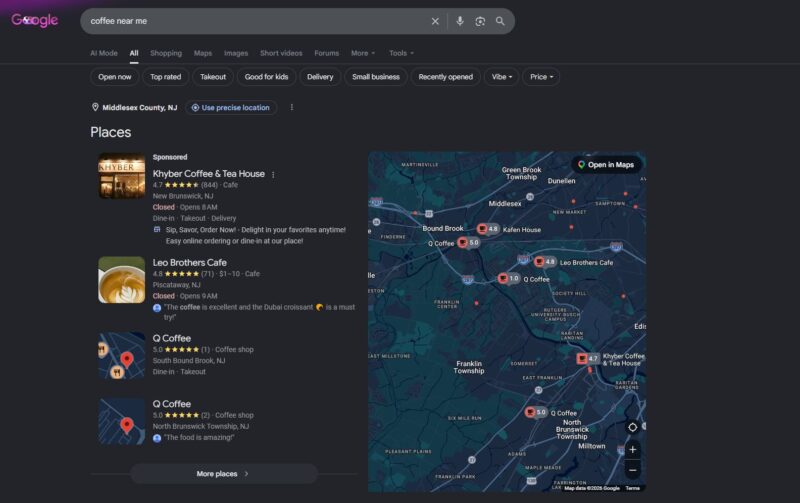
Picture the local results page as three shelves. Top shelf: paid placements, billed per click. Bottom shelf: the classic organic links, ranked on backlinks and on-page signals. The Map Pack sits between them and plays by its own rules, reputation and profile quality rather than ad budget or domain authority, which is exactly why a small operator can edge out a national brand here without spending an extra cent. Winning that middle shelf is one of the biggest wins available in local SEO, and it leans far more on your profile than on your homepage.
How Google decides which businesses appear in the Map Pack
The pack runs on a scoring system of its own, separate from the one behind the organic blue links. There is no single lever. For each search, Google blends three ingredients, and the proportions shift query by query: how well you match, how close you are, and how trusted you look.
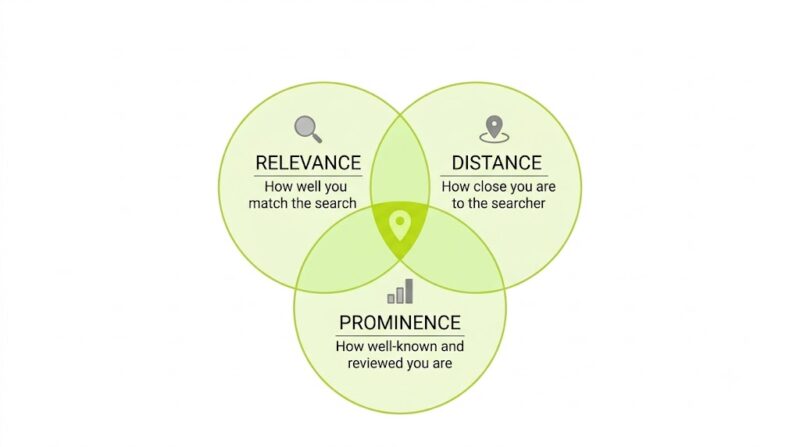
Relevance
Relevance is the fit between what someone typed and what your profile claims to do. Tighten the fit and the signal sharpens. A listing set to “Emergency Plumber,” with services and descriptions to match, beats a profile that just says “General Contractor” on the search “burst pipe repair”, even when the contractor down the road also fixes pipes. Your category and service list are not paperwork. They are ranking inputs, so name exactly what you do and the searches you want it tied to.
Distance and proximity
This one is literal: the miles between the searcher (or the place they named) and your front door. Search “coffee near me” and Google reads the phone’s GPS. Search “florist in Brooklyn” and it reaches for businesses sitting inside, or hugging the edge of, that named patch.
You can’t fake proximity. A real, verified address is the cost of admission to any given area, full stop. What a multi-branch company can do is stop treating its locations as one blurry mass: give every outlet its own optimized listing, pinned to its own street and its own part of town, and each starts competing in its own zone.
Prominence
Prominence is Google’s read on how known and trusted a business is, stitched together from signals scattered across the web. It is also the factor that rewards patience, because it gets built, not switched on. The inputs behind it:
- How many reviews you carry, and what they average
- Whether those reviews are recent, and whether the owner replies
- Mentions of the brand on third-party sites
- A name, address, and phone number that match everywhere they show up
- Your site’s authority and the local links pointing back at it
Geography fixes proximity. Prominence stays in motion. Keep earning honest reviews, keep your citations clean, answer the people who write in, and collect a few local mentions, and your place in the pack tends to hold instead of slipping the second a rival pushes harder.
The role of feedback and trust signals
Reviews pull in two directions at once. They feed Google’s ranking math, and they decide which card a person actually taps. A healthy average alongside a steady drip of fresh ratings lifts every figure that counts: taps, calls, routes opened on a map. Let the feedback go quiet or sour and the same figures sag. The link between reviews, local rankings, and revenue is one of the tightest in local search.
The bar is higher than most owners assume. In BrightLocal’s 2026 Local Consumer Review Survey, 68% of people said they would only consider a business sitting at four stars or better, up from 55% a year earlier. Put plainly: a rating that cleared the bar last year can drop under it this year without you changing a thing. Worth knowing, too, that the target isn’t a flawless score, since 4.5 stars often reads as more trustworthy than a perfect 5. Reputation is not a project you finish. It is upkeep.
Run more than a couple of locations and a second problem appears, keeping replies consistent. When nobody owns the workflow, one branch answers within a day and another within a month, the tone lurches from warm to robotic, and that patchwork slowly drains the trust the pack is meant to reward.
Trust signals weigh on placement enough that handing review duty to “whoever notices” is a gamble. Do it by hand across forty locations and you will burn the week copying replies and still miss the consistency Google grades you on. A reputation management platform exists to fold all of that into one screen. The parts worth paying for:
- One dashboard for the whole portfolio. Every location’s feedback streams, rating trend, and engagement numbers in a single view, not twelve logins and a spreadsheet that is already stale.
- Alerts the instant something moves. New feedback and rating dips surface in real time, and a sudden knot of angry reviews pings a human before it snowballs.
- Replies that stay on-brand. Templates anchor the voice; an editable body keeps each answer from sounding stamped out by a machine.
- Numbers per branch, not just per company. Review pace, rating swings, and response times split location by location, which drags the quiet underperformers into a light that a blended average hides.
None of this guarantees a ranking, no honest tool can promise one. What it does is keep the prominence signals strong and even, and even is what holds a spot over time.
Three-pack ranking comes down to proximity, relevance and prominence, and review volume feeds the last one. Automated review requests keep that flow steady: branded QR codes at each location turn a satisfied customer into a published review in a couple of taps, without anyone on staff having to remember to ask.
Errors that keep businesses out of the Map Pack
Most weak showings here are not a riddle of the algorithm. They trace back to a few avoidable slip-ups. Here is what each tends to cost:
| Slip-up |
The effect |
Why it bites |
| A primary category that’s wrong or too vague |
Google misreads the core of the business |
Relevance thins out on the exact searches you wanted to win |
| Two profiles for one address |
Reviews and authority get split in half |
Prominence weakens, and a listing can get suppressed |
| NAP details that disagree across directories |
Different sites show different facts about you |
Algorithmic trust erodes and local authority leaks away |
| Reviews ignored, or answered at random |
Complaints sit in public, unaddressed |
The business reads as inactive, and shoppers clock it |
| Stale hours or half-empty profile fields |
Searchers act on wrong information |
They bounce, and engagement signals fall with them |
| No tracking in place at all |
Trouble compounds for months, unseen |
You are flying blind, with no way to catch the trend |
Most of these are an afternoon’s work and keep paying back for months. The sneaky one is the last row: skip tracking and you can’t tell which of the others is quietly bleeding you.
Tracking and evaluating Map Pack results
A spot in the pack is not something you win once and forget. Rank is half the picture. The half that pays the bills is whether that visibility turns into someone calling or walking in.
Google Business Profile insights lay the actions out, profile views, calls, route requests, website clicks, so you can see whether the listing is doing real work. A line trending up is a good sign. A flat stretch, or a dip, is a cue to go digging.
Don’t read traffic on its own, though. Watch the reputation numbers next to it: the average rating, how fast new reviews land, how reliably the team replies. These are the reputation KPIs that actually move the needle, and they tend to wobble before placement does, which makes them an early warning instead of a post-mortem.
For a brand with many doors, the real value is in the comparison. Set branch against branch and the company-wide average stops covering for anyone, the outlet dragging ratings down, the one nobody is replying for, the location pulling half the engagement of its neighbors. That is where a fuzzy “let’s do better” becomes a short, ranked list of which location to fix first, and it is the heart of reputation management for multi-location brands.
Conclusion
The Google Map Pack catches local demand at the precise second a decision is forming, dropping nearby businesses in front of someone already reaching for their keys. What lands a listing there is the same trio every time, relevance, proximity, prominence, with ratings and review activity tipping which of the three cards gets the tap.
Holding the spot is the harder half. A profile filled to the last field, citations that agree with each other, location pages that line up, and reviews that keep arriving, that is the machinery under a ranking that lasts. Skip the reputation upkeep and even a strong start fades out.
For brands running many locations, it all comes back to doing the same thing everywhere. Accurate listings, replies that sound like the brand, and tracking that never sleeps are what keep a business parked in the pack instead of clawing its way back in.



