Pick the wrong vendor and you pay twice: once for the retainer, again as the damage keeps compounding in search results. Contracts in this market run six to twelve months, with rates from a few hundred dollars monthly to five figures, so this shortlist of online reputation management agencies and platforms serving the USA is written to survive a budget meeting, not just a skim: eight picks, the criteria behind them, real price ranges, and the traps that cost buyers the most.
How we compared online reputation management companies
Full disclosure first: ORM Service, one of the vendors covered below, is the publisher of this article. To keep the ranking useful anyway, each company is judged on what its own materials say it does best, and prices were verified on every official site; where none are public, the entry reads “custom quote” instead of a guess.
Looking for a done-for-you team instead of a tool? See our online reputation management services — plans start at $299/mo per location (pricing).
Six criteria make it possible to compare providers that sell very different things:
- Scope of work: monitoring, responses, disputes, content
- Price transparency: open rate cards beat quote-by-sales-call
- Coverage: which review and listing sites connect
- Reporting: live alerts, dashboards, benchmarks
- Contract terms: trials, month-to-month options, exit rules
- Industry fit: proof of work in the buyer’s sector
Nobody wins on all six; the ranking favors companies strong on several and honest about the rest.
Top reputation management companies at a glance
| Company |
Best for |
Key services |
Starting price |
Model |
| ORM Service |
Done-for-you review management |
Review disputes, QR review requests, multi-location dashboard |
$299/location/mo |
Hybrid |
| Thrive Internet Marketing Agency |
ORM in broader digital marketing |
ORM, SEO, PPC, social media |
Custom quote |
Agency |
| NetReputation |
Suppression, personal cases |
Removal, suppression, branding |
Custom quote |
Agency |
| Reputation X |
Custom enterprise projects |
Campaigns, content, Wikipedia |
From $3,000/mo |
Agency |
| NP Digital |
Reputation tied to SEO |
SEO, content, digital PR |
Custom quote |
Agency |
| Reputation Defense Network |
Legal-leaning removals |
Content removal, search control |
Pay per result |
Agency |
| Yext |
Listings control at scale |
Listings sync, review monitoring |
From $199/location/yr |
Software platform |
| Birdeye |
Self-serve review software |
Reviews, listings, messaging |
From $299/location/mo |
Software platform |
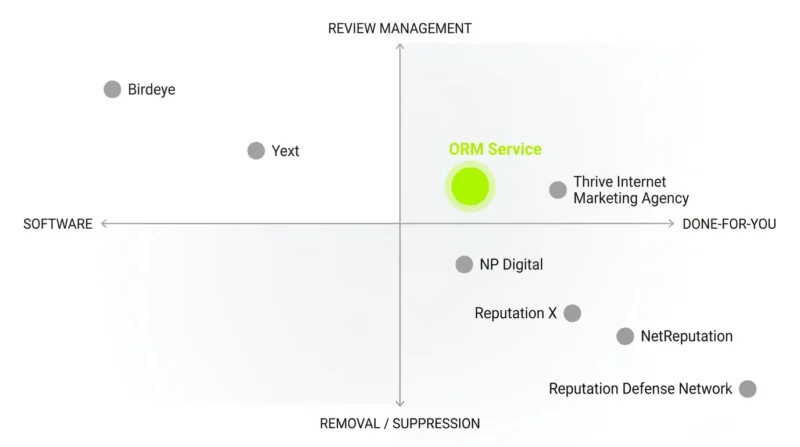
Read the table through the lens of your business type rather than rank alone. Multi-location and franchise operators gain the most from per-location models with open pricing, the corner where ORM Service and Birdeye sit: one is a managed service, the other software you run yourself.
Companies facing an acute crisis (a defamatory article, fake reviews, damaging old press) should explore NetReputation, Reputation X, or Reputation Defense Network; Thrive and NP Digital suit buyers folding online reputation into a larger marketing engagement.
The 8 best online reputation management companies reviewed
ORM Service: best overall for done-for-you review management
ORM Service rests on a single promise: the client’s staff answers no reviews, files no disputes, and learns no software. The company’s own line is “Not a Tool. A Team.” Every account comes with a dedicated four-person crew (analyst, lawyer, designer, personal manager), which is rare at a $299 entry point and earns the top spot here.
Behind the crew sits a proprietary multi-location platform: real-time alerts on negative feedback plus benchmarking across locations and competitors. Google, Yelp, Facebook, Tripadvisor, Trustpilot, OpenTable, Angi, Nextdoor, and Thumbtack all connect; hospitality, restaurants, healthcare, and franchises are the home turf. Day-to-day work includes:
Tiers cost $299, $399, and $549 per location per month, with response times and removal-attempt limits scaling upward, plus a 48-hour free trial. The top position is deliberately narrow: strongest for managed review management, whereas a defamation crisis or a Wikipedia problem belongs with the firms below.
Thrive Internet Marketing Agency: best when ORM is one piece of a wider digital marketing plan
At Thrive Internet Marketing Agency, review management shares a contract with SEO, PPC, and social media, so online reputation becomes one lever inside a full digital marketing engine. Companies that need reviews, rankings, and ads moving in step get a setup that converts the whole effort into leads.
The catch is opacity on price: nothing is published, every project gets an individual quote, and budgets only take shape after a consultation. Mid-sized businesses ready to commit to several channels at once will see the strongest return here.
NetReputation: best for content suppression and personal reputation cases
NetReputation specializes in the industry’s uncomfortable end: pushing negative articles, complaint-site posts, and outdated personal details down or out of search results. Personal cases, where a person’s own name calls up damaging material, are its signature territory.
Every project begins with a custom quote, because the company publishes no pricing. Much of the actual work is content writing and placement: positive assets engineered to outrank whatever refuses to come down.
Reputation X: best for research-heavy, custom enterprise projects
Reputation X runs each engagement like a research project: first an audit of what search engines and AI assistants show about the brand, then a bespoke mix of content, suppression, and Wikipedia work. Enterprises and public figures with layered problems get the most from that depth.
It also publishes cost guidance, a rarity in this segment: campaigns start near $3,000 per month and grow with complexity.
NP Digital: best for reputation work tied to large-scale SEO
NP Digital, the performance agency Neil Patel co-founded, treats reputation as large-scale SEO by another name: publish content that lifts positive pages until problem pages lose ground.
Brands whose problem sits on page one of Google fit best. Pricing is custom and engagements look like marketing retainers, so smaller companies with a single-platform review issue usually belong elsewhere.
Reputation Defense Network: best for legal-leaning removal requests
Reputation Defense Network leads with removal rather than marketing. The firm pairs platform-policy arguments with legally grounded pressure to pull down defamatory articles, fake profiles, and rule-breaking content, and it stays selective: cases judged unwinnable get declined up front, with rebuilding work suggested instead.
The pricing model is the standout: no ongoing retainers for removal work, with fees due only after a successful takedown.
Yext: best for listings and knowledge-graph control at scale
Yext is infrastructure rather than an agency. The platform pushes one verified record of business data out to Google, Apple Maps, Bing, Yelp, and dozens of other publishers, keeping hours and addresses consistent everywhere. Higher tiers add review monitoring; listings control stays the core product.
Published small-business plans start at $199 per location per year, with enterprise pricing quoted directly.
Birdeye: best as a self-serve software platform
Birdeye is the pick for teams that would rather run the tools themselves. One dashboard provides review collection, monitoring, response management, listings, and customer messaging, the widest self-serve toolkit on this list.
Plans start at $299 per location per month, and each location adds the full plan rate. The difference from ORM Service is labor: Birdeye equips a marketing team; a managed vendor replaces it.
What to look for when choosing an online reputation management company
A shortlist narrows the field; the criteria below pick the winner.
Experience, transparency, and case studies
Ask how long the provider has worked cases like yours, then ask for evidence. Good online reputation management firms can show anonymized case studies with before-and-after positions. A vendor that names its limits is safer than one promising everything.
Service scope: monitoring, review management, disputes, content
Fit the scope to the problem: rating-heavy operations need monitoring and dispute filing, search-result damage calls for content and SEO, defamation requires legal routes. Paying for the full spectrum when one discipline would do is the classic way to overspend.
Technology stack and reporting
Reports are how you will actually experience the vendor. Insist on a dashboard you can open yourself, alerts the moment a negative review lands, and competitor benchmarks; reporting unable to separate its own effect from natural drift never proves what you paid for.
Pricing models and contract flexibility
Four models dominate: per-location subscriptions, monthly retainers, project fees, and pay-per-result removals. Short terms and trials move risk onto the vendor; treat a mandatory 12-month contract with a setup fee as an opening bid, not a rule.
How much online reputation management typically costs
The model sets the budget more than the vendor does. Self-serve software spans $199 per location per year for listings tools up to roughly $300-450 monthly per location for review suites, and done-for-you review management occupies a similar per-location band with labor included.
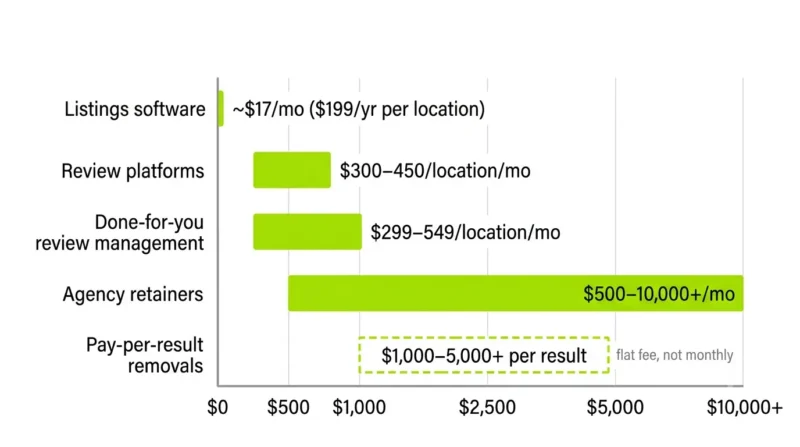
Agency retainers for suppression and crisis work commonly run from about $500 a month for small local cases to $10,000 and beyond for enterprises; removal projects are often flat fees. When comparing online reputation management services, price the resolved problem rather than the month: a $5,000 removal that ends a crisis beats a $500 retainer that babysits it forever.
Common mistakes when selecting an ORM partner
Hiring for promises instead of mechanisms is the priciest mistake of all. “Guaranteed” removal of truthful reviews, page-one placement, or fixed timelines are red flags, since no vendor controls the platforms or search engines, and firms claiming otherwise tend to deliver fake reviews and spam. Discover the mechanism a provider plans to use before signing anything.
Two further patterns repeat across bad engagements: buyers weigh the pros of each pitch yet never call former clients, and they lock in long contracts before testing responsiveness on a small scope. Start narrow, measure for a quarter, then expand with the online reputation management company that earned it.



