Fifty one-star ratings, all posted between midnight and dawn, almost none from anyone who ever bought from you. That’s review bombing: a coordinated pile-on meant to punish a decision, not to describe a real experience. The people behind it rarely care about the product. They care about sending a message, and your rating is the megaphone.
The harm lands even though the complaints are hollow. Watch a 4.6 average slide to 3.1 over one weekend and you’ll feel it in bookings and search rankings weeks before a single fake entry comes down. What follows is a practical walk through the whole problem: spotting a coordinated hit, telling it apart from honest anger, filing reports that actually stick on Google and elsewhere, and clawing your score back afterward.
What is review bombing and why it happens
Review bombing is a tactic: a large number of users purposefully flood one listing with negative feedback inside a tight window, dropping a wall of one-star ratings on a website or app. The mark might be a diner on Google, a game on Steam, a novelist on Goodreads, or any company that made a call somebody hated. The common thread isn’t quality. It’s motive. These posts answer something other than the actual product or service being reviewed. Most waves rate a target negatively to sink its score; a smaller share runs the other way, padding a weak product positively.
The spark is usually something off to the side of the product. A casting choice. A price bump. A moderation call, or an owner who said the wrong thing in public. People organize on forums and social platforms, then march to the review section because that’s where the anger bites hardest. None of this is new; social media just made the mob assemble in hours instead of weeks. When it works, the point was never feedback. A sunk average scares off strangers who never learn what set the whole thing off.
Notorious examples and common tactics
The word got its start in 2008, when angry players buried the game Spore under one-star Amazon reviews aimed at its copy protection, not its gameplay. The habit stuck. The Last of Us Part II cratered on Metacritic user scores days after launch, tanked by people furious about the plot rather than anyone who’d played to the end. Local businesses live the same story on Google and Yelp whenever a clip goes viral or a staffing fight spills online.
Patterns give these campaigns away. Timing clusters. Wording repeats. Ratings show up as a bare star with nothing written behind them. Bombers often strike right before a launch, trying to poison first impressions early, and while some hide behind throwaway accounts, others rally real users who feel wronged.
Is review bombing illegal?
There’s no clean yes or no. It rides on what the attackers actually do and which laws reach them. A blunt, honest opinion is protected speech almost everywhere. A coordinated push can slip into illegal territory when it carries defamation (false claims of fact dressed up as truth), extortion, or bought reviews.
Commerce is where the line sharpens. In the US, the Federal Trade Commission’s rule on consumer reviews has been in force since October 21, 2024, and it makes buying or selling fake reviews illegal, along with paying anyone for feedback that leans either positive or negative. So a company that pays a service to bomb a rival, or to stuff its own page with praise, has already broken the law, even when one furious customer hasn’t. On top of that, most big platforms count coordinated fakes as a policy breach no matter what the local statute says, which is usually the quicker path to takedown. Once threats, money, or outright lies enter the mix, ask a lawyer whether your particular case crosses the line.
Paid bot reviews on Google and similar schemes
Plenty of attacks aren’t grassroots at all. A paid market exists: a business can order a stack of one-star hits on a competitor, or a stack of glowing fakes for itself, straight from review farms, bot networks, and gig-site freelancers. That’s exactly the traffic detection systems chase hardest.
Google files it under fake engagement. Trading in reviews, buying or selling them, breaks the rules, and a caught business can lose ratings and land under profile restrictions, warning banner and all. Oddly, a bot-run bomb is often simpler to clear than an organic one. The very thing that makes it work, matching timestamps and copy-paste text, is the fingerprint that trips the spam filter.
How to identify a coordinated attack
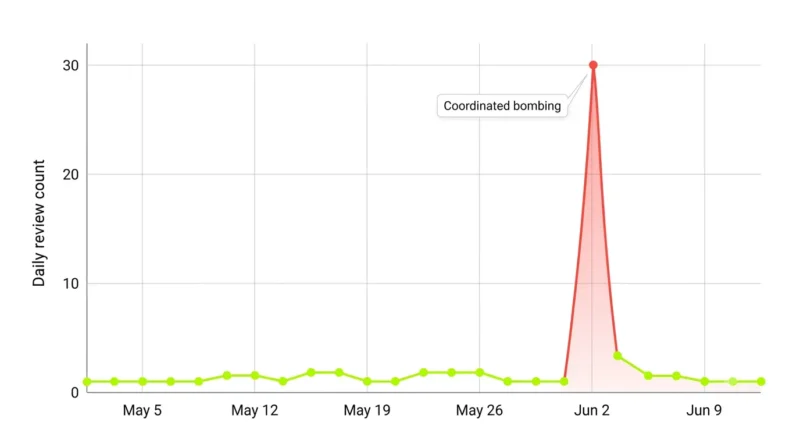
Speed gives it away first. Honest opinions dribble in over weeks; a bombing hits like a burst, dozens or hundreds of one-stars crammed into a day or two. Don’t swing back before you’re sure, though. A genuine service meltdown can also trigger a rush of angry posts, and mistaking real customers for a mob is its own kind of damage.
A short audit sorts it out. Check the clock, the wording, the reviewers’ backgrounds, and whether any complaint matches something that truly happened on your premises. Spot it early, while the entries are fresh and simple to screenshot, and everything downstream gets easier.
Signs of fake reviews and suspicious velocity
A few tells tend to travel together:
- Velocity out of nowhere: volume jumps with no sale, press hit, or event to explain it.
- Empty ratings: one stars with no text, or the same two or three lines pasted across dozens of entries.
- Wrong subject: the complaint is about a controversy, a person, or politics, not the product or service reviewed.
- Fresh accounts: no photo, no history, or a single day’s burst of ratings sprayed across unrelated businesses.
- Impossible geography: a lot of angry posts from people who could never have set foot in the place, the giveaway when a neighborhood shop gets bombed from three states away.
One flag on its own means little. Stack three or four across a same-day cluster and you’re almost certainly looking at fake reviews, not earned ones.
Tools and signals platforms use for detection
Owners aren’t the only line of defense. Google, Yelp, Steam, and the big aggregators run scoring systems that grade each post for authenticity and yank spam on their own. They read things no human can track by hand: how old an account is, device and IP fingerprints, posting speed, near-identical text, and webs of accounts that keep hitting the same targets in concert.
After the ugly public cases, some sites added speed bumps too. Rotten Tomatoes shut the door on audience reviews before a film opens and bolted on a verified-ticket check after 2019’s Captain Marvel pile-on; Steam runs histograms so a brief spike stands apart from a long slow decline. Google will pull entries mid-attack while it separates signal from noise. The lesson for you is blunt: your documentation feeds the same engines, and a tidy, evidenced report clears faster than a vague gripe.
Distinguishing genuine criticism from weaponized commentary
The tough cases wear a disguise: they look like an assault but hold a real grievance. A price hike, a layoff, a genuinely bad visit, any of these can set off honest one-stars that also happen to bunch up in time. That’s not review bombing, however much it stings, and flagging it as fake usually flops and reads like you’re burying legitimate feedback.
Judge the substance, not the mood. A critical review that walks through the actual product, visit, or service, however brutal, is protected commentary; answer it, don’t report it. A post that weaponizes an unrelated controversy, names no real experience, and rolls in on a coordinated tide is the kind platforms will strike. Mixed batch? Split it. Report the rule-breakers, reply to the honest critics, and let the fair negative ones stand.
How to report inappropriate reviews (Google and beyond)
Reports only work when a post actually breaks a written policy, so pin each one to a specific rule before you flag it. Google removes reviews that violate its content policies, from spam and fake engagement to conflicts of interest, off-topic content, and harassment, but it won’t touch a review just because it’s negative or you’d rather it vanished.
The mechanics are quick: open your Business Profile, flag the entry, pick the reason that matches, and track the outcome in the Reviews Management Tool, which also lets you file a one-time appeal if Google decides a review stays. A coordinated wave takes more legwork. Flag each offender, document the pattern (near-identical wording, same-day timing, accounts with no real history), and escalate to Business Profile support when the automated sweep misses them. If the reviews come with a threat, that’s review extortion, which Google handles through a dedicated report. Evaluation usually runs several days, and removal is never guaranteed, so keep a dated log of what you send.
Other platforms follow the same logic even when the buttons differ: match the review to a specific policy, flag it, and back it with evidence. Screenshots, timing, and anything showing the post isn’t based on a real, direct experience strengthen a report, though none of it forces a removal. For the platform-by-platform detail this overview skips, our guide to spotting and handling fake reviews goes deeper.
How to recover your reputation after an attack
Takedowns crawl, so rebuilding your reputation after the hit moves on two rails at once: leaning on the platforms to scrub the fakes, and drowning whatever’s left in real activity. While the reports sit in a queue, the one lever fully in your hands is your own reply.
Answer in public, short and level. A calm owner note under a blatant bomb, something like “we have no record of this visit and have flagged these entries,” tells the next reader the storm wasn’t about your service, without stooping to match the rage. Don’t bicker. And never buy positive reviews to paper over the dip, that’s the identical violation the attackers just committed, and it can get your profile frozen.
A handful of moves shorten the climb:
- Ask happy regulars for honest reviews, so fresh, real feedback outweighs the spike and nudges the average back toward normal.
- Reply in public to the fakes and to any real critics, keeping every word factual.
- Build a dossier, screenshots plus a timeline, that you can reuse across each platform’s report and appeal.
- Watch your other channels, since one crew often lights up Google, Yelp, and your social pages in the same afternoon.
Give it weeks, not hours. A score dragged under by a hundred fake one-stars recovers as takedowns land and honest entries pile up, but the pace hangs on how fast the platform moves and how lively your real customer base is.
Prevention: building resilience against future attacks
You can’t stop people from getting angry. You can make the next bombing survivable. The businesses that shrug one off are the ones already sitting on a deep, steady bank of honest reviews, because a hundred fresh fakes barely dent an average built on two thousand real ratings.
Resilience is mostly boring maintenance. Keep asking pleased customers for reviews so your baseline stays high and current. Watch your listings and wire up alerts, so a spike pings you in hours, not next month. Claim and verify every profile, which is what hands you the reporting tools and the standing to escalate in the first place. And where you can, sidestep the public own-goals that draw a mob, since a lot of bombings trail an avoidable flashpoint that a little foresight would’ve cooled.
If the volume outruns what you can handle in-house, a review dispute service can take over the flagging, documentation, and appeals; share the specifics to learn what’s realistically removable.



